How to Choose Grader Blades: Boron Steel vs. High-Carbon Steel
The least expensive grader blade is not always the lowest-cost blade. The right decision depends on the material being graded, impact level, abrasion, machine utilization and the cost of a planned blade change.
This guide compares heat-treated boron steel and high-carbon steel as decision categories. Exact chemistry, hardness and heat treatment vary by manufacturer, so confirm the specification and part number before ordering.
Quick answer: high-carbon steel is often a practical choice for lower-impact work and price-sensitive fleets. Heat-treated boron steel is usually worth evaluating when abrasion, impact or change-out downtime drives total cost.
Start with the application, not the alloy name
Record the dominant job condition before comparing quotations:
| Site condition | What it does to an edge | Selection priority |
|---|---|---|
| Sand, loose soil, snow | Mostly sliding abrasion, limited shock | Economy and predictable wear |
| Compacted gravel | Abrasion plus intermittent impact | Balanced hardness and toughness |
| Broken rock or quarry roads | High abrasion and repeated shock | Toughness, wear life and edge retention |
| Finish grading | Profile control matters | Consistent geometry and clean mounting |
Caterpillar classifies grader cutting edges by duty: general-duty edges for lower-to-moderate impact, heavy-duty edges for high impact and abrasion, and specialty systems for particular conditions. That reinforces the central point: material and profile must match the work, not just the machine model. See the Cat motor grader cutting-edge guide.
Material comparison
| Decision factor | High-carbon steel | Heat-treated boron steel |
|---|---|---|
| Initial price | Usually lower | Usually higher |
| Wear resistance | Suitable for many general applications | Often selected for severe abrasion |
| Impact tolerance | Depends strongly on hardness and heat treatment | Designed to combine hardenability with toughness |
| Best business case | Low utilization, light duty, easy change-outs | High utilization or costly downtime |
| Main verification | Grade, hardness range, dimensions | Grade, heat-treatment record, hardness profile, dimensions |
Do not choose from a hardness number alone. A very hard edge can still be a poor fit if the application creates impact loads beyond the edge’s toughness. Ask the supplier for traceable material and heat-treatment information, then validate performance on your own site.
Cost-per-hour analysis
Use total planned cost rather than purchase price:
Cost per operating hour = (part price + change labor + planned downtime cost) ÷ achieved service hours
The following model is illustrative, not a market-price or life claim.
| Example input | High-carbon edge | Boron-steel edge |
|---|---|---|
| Part price | $420 | $720 |
| Labor per planned change | $90 | $90 |
| Planned downtime cost | $180 | $180 |
| Observed service life | 380 h | 760 h |
| Calculated cost/hour | $1.82 | $1.30 |
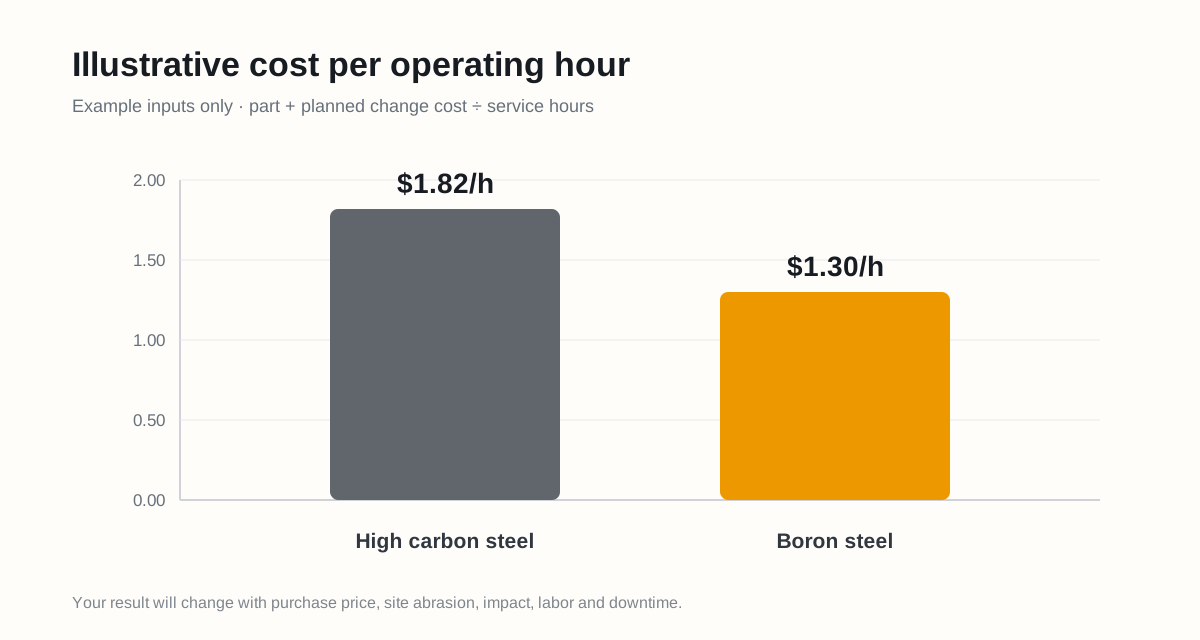
Figure 1. Example model only. Replace every input with your quotation, labor rate, downtime value and measured site life.
The calculation shows why a higher-priced edge can cost less per hour. It does not prove that boron steel will last twice as long at every site. Track actual hours, material handled and failure mode before standardizing a fleet.
A controlled site trial
- Choose two comparable machines, operators and routes.
- Photograph and measure new-edge dimensions at installation.
- Record operating hours and dominant material each shift or week.
- Measure from the bolt center to the working edge at consistent points.
- Record abnormal events: rock strikes, loose hardware and edge rotation.
- Stop at the wear limit stated in the machine’s Operation and Maintenance Manual (OMM).
- Compare cost per hour and cost per tonne or lane-kilometre, if production data is available.
Ordering checklist
- OEM or verified cross-reference part number
- Overall length, width and thickness
- Hole diameter, countersink type, pitch and edge distance
- Left/right or reversible geometry
- Material grade and heat-treatment condition
- New bolts and nuts where required
- Machine-specific torque and wear-limit data from the OMM
Recommendation
Choose high-carbon steel when the work is moderate, changes are easy and the measured total cost supports it. Trial heat-treated boron steel when abrasion, impact or downtime dominates. The winning blade is the one with the lowest verified cost per productive hour while protecting the moldboard.
Sources
- Caterpillar: Motor Grader Cutting Edges Replacement Guide
- Caterpillar: Cutting Edge Systems and installation tips
- Caterpillar: Ground Engaging Tools for Construction
Safety note: this guide is general reference information. Follow the OMM, site lockout procedures and approved lifting methods for the exact machine.