Bucket Tooth Wear Patterns: What They Reveal About Your Jobsite
A worn bucket tooth is more than a consumed part. Its shape records how the bucket entered the material, where impact occurred and whether the tooth, adapter and retainer worked as a system.
Stop-work signals: a missing or loose retainer, a crack into the pocket, a tooth worn through on the bottom, or an adapter strap worn into its cavity requires prompt action. Caterpillar includes these conditions in its GET maintenance guidance.
Five patterns to recognize
| Pattern | Visual clue | Likely contributors | Next check |
|---|---|---|---|
| Even shortening | Nose stays centered and profile reduces uniformly | Normal abrasion for the selected tooth | Compare remaining usable material with the product limit |
| Bottom wear | Underside thins faster than the top | Shallow scraping, long carry, abrasive floor | Operating technique, bucket angle, underside protection |
| One-sided wear | One flank is rounded or shortened | Side loading, skewed approach, uneven material flow | Adapter alignment, bucket geometry, operator pattern |
| Mushrooming or deformation | Nose spreads instead of wearing cleanly | Repeated high impact or material/profile mismatch | Impact class, tooth style, material condition |
| Cracks at pocket or ear | Sharp line near retention area | Impact overload, loose fit, damaged adapter or installation issue | Remove safely and inspect adapter and retainer |
Not every uneven tooth proves a machine fault. Mixed material, slope work and operator technique can create local variation. Diagnose from a set of teeth and a time series, not one discarded part.
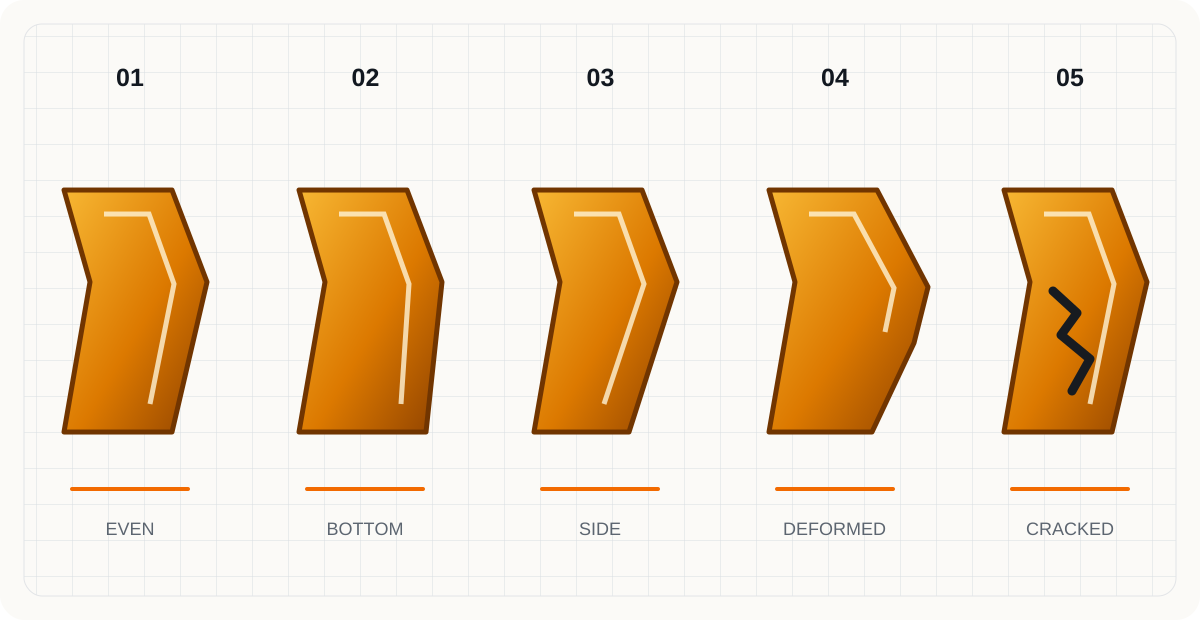
Figure 1. Use the pattern as a screening clue, then confirm the cause by inspecting the full tooth line, adapters and retention hardware.
A useful inspection sequence
Perform a walk-around before the shift, when the bucket is clean enough to inspect safely:
- Confirm every tooth and piece of retention hardware is present.
- Look for cracks, through-wear and abnormal asymmetry.
- Lightly check retainers using the method approved for the system; replace any retainer that is loose or damaged.
- Inspect adapters, especially the lower strap and pocket contact surfaces.
- Check the base edge, corner welds, sidewalls and wear plates.
- Photograph the full tooth line from the front and underside.
Caterpillar’s inspection guidance likewise calls for checking teeth and hardware, base-edge cracks, sidewalls and bucket pins. See Inspecting Your Bucket.
Turn observations into data
Use the same fields every time:
| Field | Example |
|---|---|
| Machine / bucket ID | EX-07 / 1.2 m³ GP bucket |
| Tooth position | Left corner, L2, center, R2, right corner |
| Operating hours | 642 h at inspection |
| Material | 70% blasted rock, 30% clay |
| Remaining reference dimension | 86 mm from fixed datum |
| Pattern code | Bottom wear + right-side bias |
| Retainer condition | Secure / loose / missing |
| Action | Continue, rotate if approved, replace, inspect adapter |
Example wear-rate calculation
If a reference dimension drops from 142 mm to 106 mm over 300 hours:
Wear rate = (142 − 106) ÷ 300 = 0.12 mm/h
If the approved replacement reference is 90 mm, a simple linear estimate gives:
Estimated remaining hours = (106 − 90) ÷ 0.12 ≈ 133 h
This estimate is only a scheduling aid. Wear often accelerates when the profile changes or the machine moves to a more abrasive bench. Shorten the inspection interval as the limit approaches.
What the pattern suggests about tooth selection
Caterpillar describes selection as a balance between penetration and wear life. Specialized profiles use different amounts of usable wear material and different leading-edge geometry; more wear material is not automatically better if penetration suffers. See What to Know About Ground Engaging Tools.
- Frequent blunt, evenly worn noses in abrasive material: evaluate an abrasion-oriented profile.
- Good wear life but slow penetration: evaluate a sharper penetration profile.
- Repeated cracking: reduce impact, inspect fit and adapters, and review the duty class.
- Corner teeth consuming much faster: review side loading and corner protection before changing every tooth.
Replacement decision
Replace according to the tooth-system manual, not appearance alone. Never allow a sacrificial tooth to wear into the adapter. A cheaper tooth run too long can turn a planned tooth change into an adapter and base-edge repair.
Sources
- Caterpillar: What to Know About Ground Engaging Tools
- Caterpillar: General Duty and Heavy Duty Tips — bucket inspection
- Caterpillar: Excavator and Wheel Loader Bucket Tips
Safety note: lower, isolate and support the attachment according to the OMM before close inspection or replacement. Do not work beneath an unsupported bucket.