How to Choose the Right Bucket Tip Profile for the Material
The best bucket tip is not simply the one with the most steel. A thick abrasion tip may last longer in sliding wear but need more force to enter compacted material. A narrow penetration tip may fill the bucket efficiently yet provide less sacrificial material in severe abrasion. Selection is a balance among penetration, strength and wear life.
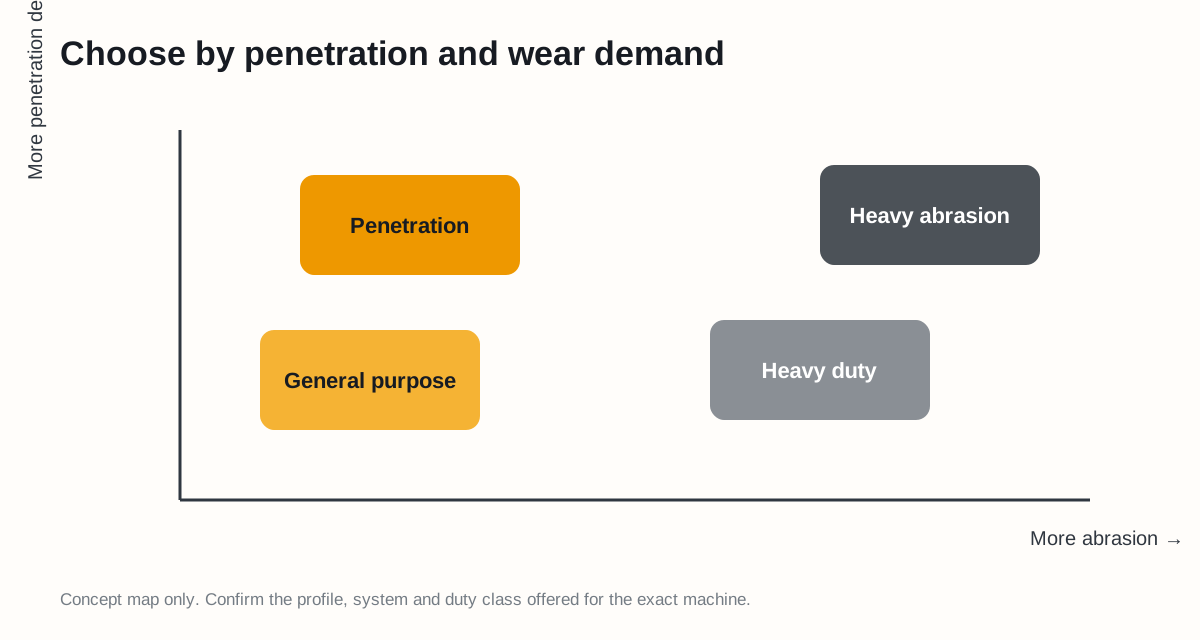
Figure 1. Concept map only. Available profiles and duty classes differ by manufacturer and tooth system.
Start with three questions
- What material dominates the shift? Loose soil, cohesive clay, compacted gravel, blasted rock and quarry floor create different resistance.
- Is failure driven by abrasion or impact? Smooth shortening suggests abrasion; cracks and deformation point to impact, fit or duty problems.
- What matters most to production? Fast penetration, flat-bottom finish, maximum wear life, low payload penalty or a balanced general-purpose setup?
Profile guide
| Profile family | Typical strength | Best starting conditions | Trade-off to verify |
|---|---|---|---|
| General purpose | Balanced and symmetrical | Mixed earthmoving and standard soil | May be neither the sharpest nor longest-wearing choice |
| Penetration / spike | Small leading contact area | Compacted, cohesive, rocky or frozen material | Less wear volume and possible side-load sensitivity |
| Wide | Broad working face | Easy-to-penetrate, low-abrasion material; smooth trench floors | Higher penetration resistance in hard material |
| Heavy duty | More usable wear material | Higher impact and abrasion | Added mass and contact area |
| Heavy abrasion | Maximum wear emphasis | Severe sliding abrasion with controlled impact | Penetration and payload penalty must be tested |
Caterpillar describes general-purpose tips as the baseline, penetration tips as suited to compacted material, and wide tips as useful for smooth trench floors in low-abrasion material. Its product-specific percentages—such as more wear material or smaller leading area—apply to those Cat designs, not to every aftermarket tooth. See Cat bucket tip guidance.
Use the wear pattern as feedback
- Tip stays sharp but disappears quickly: keep the profile idea but evaluate a higher-wear option.
- Tip becomes blunt early: choose a self-sharpening or penetration-oriented profile.
- Pocket cracks or pin moves: stop treating it as a profile-only problem; inspect retention and adapter fit.
- Corner teeth wear much faster: examine side loading, corner protection and operator path.
- Machine works harder after fitting larger teeth: added contact area may be reducing penetration.
Caterpillar warns that excessive contact area can increase resistance, fuel use and time required to move material. See GET selection and maintenance.
A simple site trial
Compare candidate tips on similar machines or alternating controlled periods. Record:
| Metric | Why it matters |
|---|---|
| Operating hours | Basic exposure measure |
| Material and route | Prevents false comparisons |
| Tip mass or reference dimension lost | Measures consumption |
| Cycles or tonnes moved | Connects wear to production |
| Fuel per tonne, where available | Reveals penetration penalty |
| Adapter and retainer condition | Confirms system protection |
Calculate cost per productive unit rather than cost per tooth:
GET cost per tonne = (tips + retainers + change labor + planned downtime) ÷ tonnes moved
Do not claim a winner from a short trial with different operators and material. The result is site-specific.
Ordering checklist
- Tooth system, series and size
- Excavator or loader application and bucket position
- Machine model and serial range
- Tip profile and duty class
- Matching pin/retainer version
- Adapter condition and compatible nose
- Required service tool and safe replacement method
Sources
- Caterpillar: Excavator and Wheel Loader Bucket Tips
- Caterpillar: What to Know About Ground Engaging Tools
- Caterpillar: Choosing the Right Ground Engaging Tools
Safety note: use only tips, adapters and retention parts approved as a compatible system. Follow the OMM before inspection or replacement.