When to Replace Loader Cutting Edges: A Data-Based Method
The best replacement time is neither “when the edge looks old” nor “when all usable steel is gone.” It is the point that preserves the base edge, maintains penetration and leaves enough time for a controlled change.
Four reasons to replace or escalate
- The manual’s dimensional limit is reached. Use the datum and limit for the exact edge and machine.
- Damage creates an immediate risk. Cracks, missing fasteners, loose sections or deformation require prompt assessment.
- The sacrificial edge no longer protects the bucket structure. Do not run wear into the base edge or adapter.
- Performance deteriorates. Poor penetration, longer cycles or increased machine effort can indicate that the edge profile is no longer effective.
Caterpillar recommends daily GET inspections and calls out cracks, excessive wear, damaged tips and damaged retainers as replacement indicators. See Cat Ground Engaging Tools and GET selection and maintenance.
Measure from a repeatable datum
For many bolted edges, a stable method is the distance from a bolt center to the working edge. Caterpillar specifically recommends this method for grader edges, then comparing the result with the OMM. Loader edge geometry varies, so confirm the correct datum in the machine documentation.
Use the same locations every time:
- Left, center and right positions
- Same tool and measurement direction
- Clean surface and documented temperature/condition if precision matters
- Photograph with the scale visible
Example trend and forecast
The chart below uses fictional fleet data. The example edge starts near 25 mm and has an illustrative 12 mm minimum.
| Operating hours | Measured thickness |
|---|---|
| 0 | 24.2 mm |
| 250 | 21.8 mm |
| 500 | 19.1 mm |
| 750 | 16.0 mm |
| 1,000 | 13.4 mm |
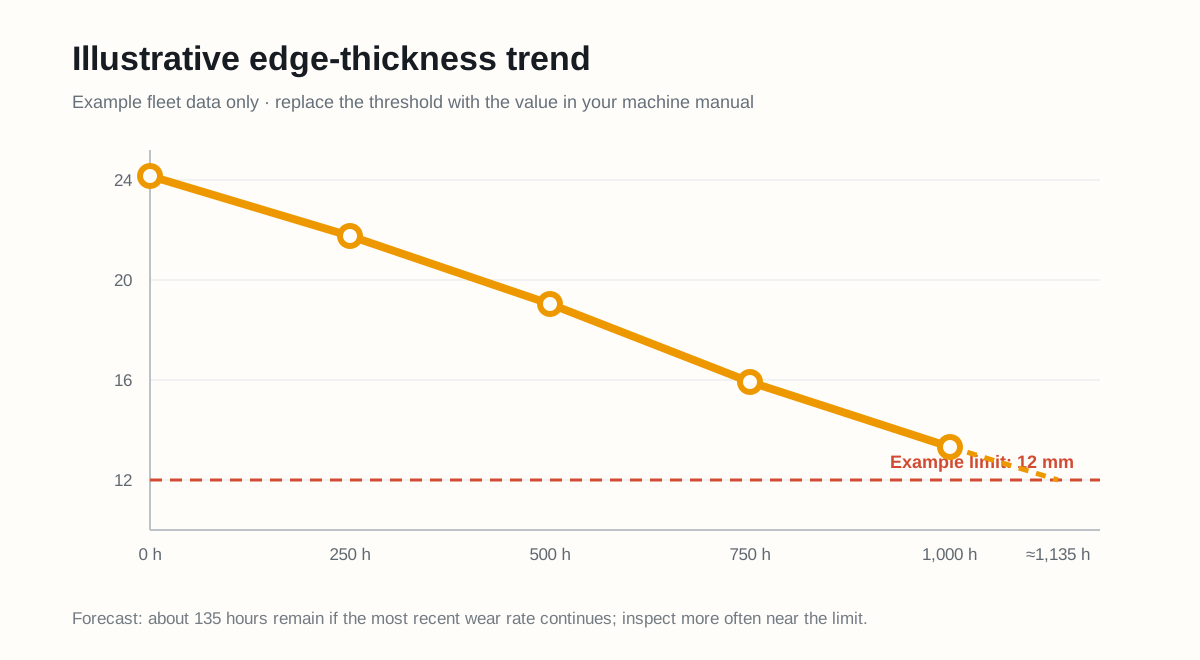
Figure 1. Example only. The dashed extension is a scheduling forecast, not a guaranteed wear curve.
The latest interval lost 2.6 mm over 250 hours:
Recent wear rate = 2.6 ÷ 250 = 0.0104 mm/h
Remaining allowance at 1,000 hours:
13.4 − 12.0 = 1.4 mm
Simple remaining-life estimate:
1.4 ÷ 0.0104 ≈ 135 hours
Do not schedule the change at hour 1,135 with no margin. Material, operator and route changes can accelerate wear. Increase inspection frequency and plan the change before the predicted crossing.
Use a three-level decision rule
| Status | Typical condition | Action |
|---|---|---|
| Green | Ample allowance, even wear, secure hardware | Continue routine inspection |
| Amber | Near planning threshold, increasing wear rate or mild asymmetry | Order parts, shorten interval, book downtime |
| Red | At limit, cracked, loose, missing hardware or base edge exposed | Remove from service and follow the approved repair procedure |
Set the amber threshold from lead time. If parts and workshop availability require 80 operating hours, the planning threshold must be earlier than a fleet with parts on the shelf.
Include production cost
Track more than thickness:
- Fuel per tonne or per cycle
- Average cycle time
- Bucket fill factor, where measured reliably
- Operator comments on penetration
- Fastener loosening events
- Material and route changes
- Planned and unplanned downtime
A worn profile can remain physically attached while quietly reducing productivity. Conversely, changing too early discards usable material. Combining dimensions with production data makes the trade-off visible.
Replacement planning checklist
- Verify the OMM wear datum and limit.
- Plot at least three measurements before forecasting.
- Use the fastest-wearing position to protect the structure.
- Confirm part number, hole pattern and edge orientation.
- Prepare specified new fasteners and torque data.
- Schedule supports, lifting equipment and trained personnel.
- Photograph and retain the removed edge long enough to review its wear pattern.
Sources
- Caterpillar: Ground Engaging Tools
- Caterpillar: GET Selection and Maintenance
- Caterpillar: Motor Grader Cutting Edges Replacement Guide
Safety note: the machine-specific OMM controls inspection, support, wear limits, fasteners and replacement procedures.